
There is no single best brake pad material, only the right material for a given market. A distributor who imports the wrong mix ends up with slow stock in one line and shortages in another. The distributors who grow are the ones who match what they import to what their market actually wants. This guide is a practical framework for that decision: how to read your market and choose which brake pad materials to import and in what proportion.
Each material has its own detailed sourcing guide, linked below. This article sits above them and helps you decide the mix. For the technical background, see our brake pad materials breakdown and types of brake pads.
Why Material Choice Is a Market Decision
The same pad that sells well in one country can sit unsold in another. Comfort-first buyers reject noise and dust; performance and heavy-duty buyers want heat handling; price-sensitive markets prioritise value. Treating material selection as market segmentation, rather than a one-size-fits-all choice, is what keeps your stock moving and your customers served.
The Four Materials at a Glance
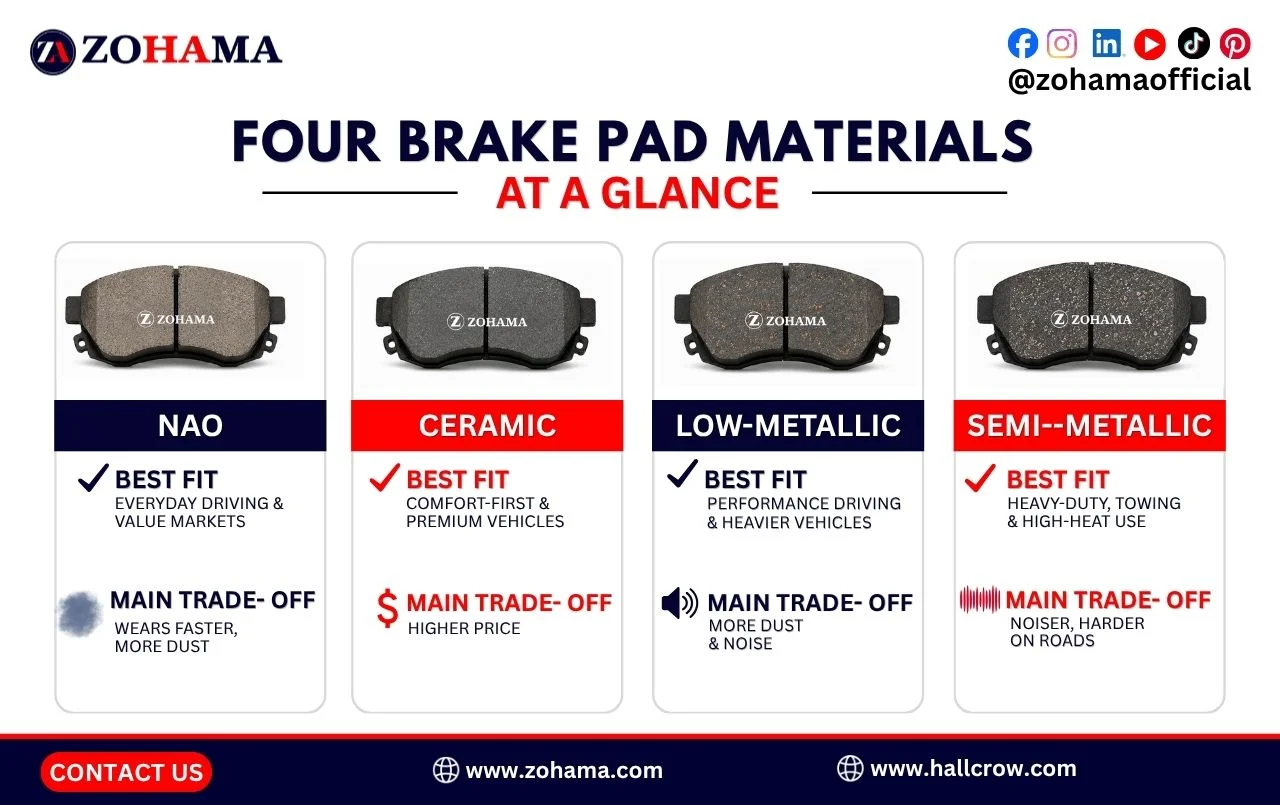
Start from a clear view of what each material does best and its main trade-off:
| Material | Best fit | Main trade-off |
|---|---|---|
| NAO | Everyday, economy and value-driven markets | Wears faster, more dust |
| Ceramic | Comfort-first and premium passenger markets | Higher price |
| Low-metallic | Everyday performance and heavier cars | More dust and noise |
| Semi-metallic | Heat, heavy-duty and towing use | Noisier, harder on rotors |
Each has a full sourcing guide: ceramic, NAO, low-metallic and semi-metallic.
Read Your Market Before You Import

Before deciding the mix, assess the factors that shape demand in your market:
- Climate and terrain. Hot or hilly regions push demand toward heat-handling materials.
- Vehicle mix. Economy cars, heavier vehicles and utility use each favour different materials.
- Customer priorities. Comfort, performance or price, and which matters most to your buyers.
- Price sensitivity. How much the market will pay for premium versus value.
- Regulations. Compliance such as ECE R90 or copper-free rules that apply in your market.
Matching Material to Market
With your market read, use this mapping as a starting point for what to prioritise importing:
| If your market is… | Prioritise importing |
|---|---|
| Comfort-first and premium | Ceramic first, with NAO for the value tier. |
| Price-sensitive, high-volume everyday | NAO as the core line, with some ceramic for premium demand. |
| Heavier cars and everyday performance | Low-metallic, alongside NAO and ceramic. |
| Hot or hilly, towing and heavy-duty | Semi-metallic and low-metallic for heat and durability. |
| Strictly regulated (e.g. copper-free) | Compliant versions across every material you carry. |
Treat this as a guide, not a rule. Most markets need a blend, weighted toward the materials your demand favours.
Building a Balanced Import Mix
Rarely should you import only one material. A balanced mix protects you against gaps and lets you serve every customer:
- Lead with the material your market favours most and stock it deepest.
- Carry supporting materials in smaller volumes for the rest of your demand.
- Adjust the mix over time as your sales data shows what actually moves.
- Keep it lean by not over-importing specialist materials your market barely needs.
Standardise Quality Across Materials
Whatever mix you import, apply the same quality discipline to every material: approve a sample, check each batch against it, and confirm compliance. Consistency across materials is what makes a multi-material range manageable. See our quality checks for car brake pads, and for the volume-buying process see bulk buying car brake pads.
Import the Right Mix With Confidence
The right import mix is the one that matches your market, and a manufacturer that produces all four materials makes it far easier to build and adjust. Explore our distributor and partner program to request a catalogue and pricing across every material for your market.
Frequently Asked Questions
Which brake pad material should I import?
It depends on your market. Comfort-first markets favour ceramic and NAO; performance and heavy-duty markets favour low-metallic and semi-metallic; price-sensitive markets lean on NAO. Most markets need a weighted blend.
Should I import just one material?
Rarely. Lead with the material your market favours and stock it deepest, but carry supporting materials in smaller volumes so you can serve every customer and avoid gaps.
How do I decide the right mix?
Read your market first: climate, terrain, vehicle mix, customer priorities, price sensitivity and regulations. Then map those to materials and adjust the mix over time using your sales data.
How do I manage quality across several materials?
Apply the same discipline to all of them: approve a sample, check every batch against it, and confirm compliance. Consistency is what makes a multi-material range work.
Conclusion
Matching brake pad material to market is what turns a parts catalogue into a well-run business. Understand what each material does best, read your market honestly, map the two together, and import a balanced mix weighted toward real demand. Do that, keep quality consistent across materials, and adjust as your data guides you, and every line you carry earns its place on the shelf.