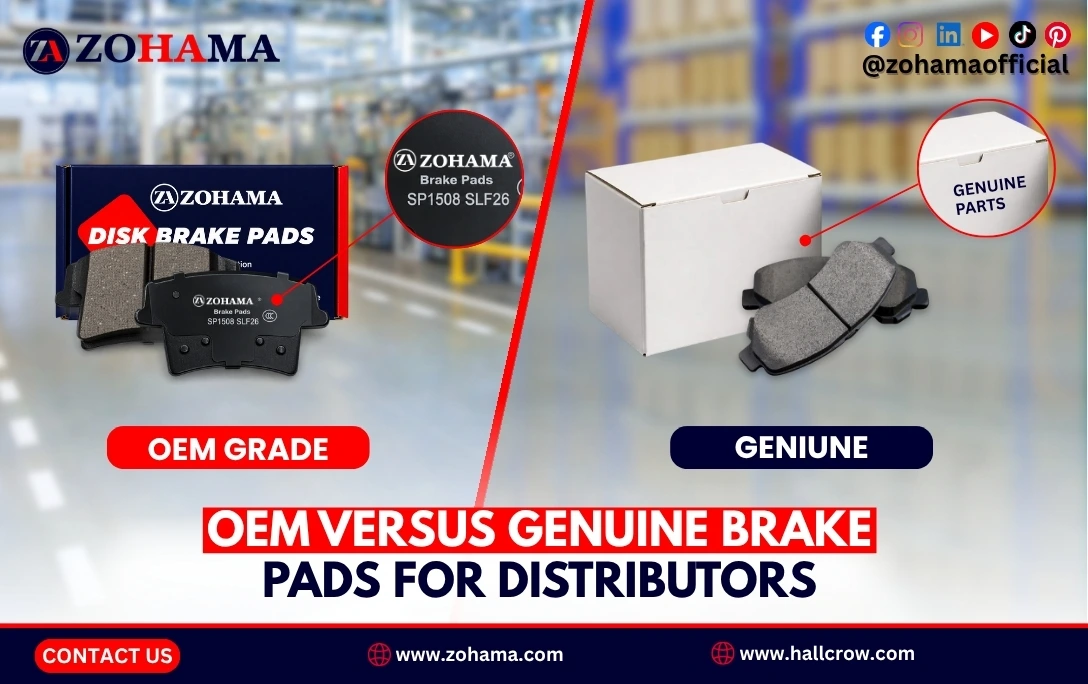
“Genuine,” “OEM” and “aftermarket” are thrown around as if they were three clear categories, and buyers lose money on the confusion. A distributor who orders only dealer-genuine pays too much and cannot compete on price; one who orders bottom-end aftermarket inherits the returns. The useful question is not which label sounds best, but what each actually means and which one a distributor should order. This guide clears up the terms and makes the case for the order that serves most customers best.
What the Terms Actually Mean
Three terms, three different things, and the differences are where the money is:
- Genuine: the pad sold in the vehicle maker’s own branded box, through their dealer network, usually at the highest price.
- OEM-grade: a pad built to the original-equipment fit, form and friction specification, carrying the OE reference, made by a manufacturer rather than the car brand.
- Aftermarket: a broad term covering everything from OE-standard pads down to commodity copies, which is why the word alone tells a buyer very little.
The key point is that a genuine pad and an OEM-grade pad are often made to the same specification; the main difference is the box and the price. Zohama’s OEM brake pads are built to that OE specification and listed by number.
Genuine vs OEM-Grade: The Real Difference
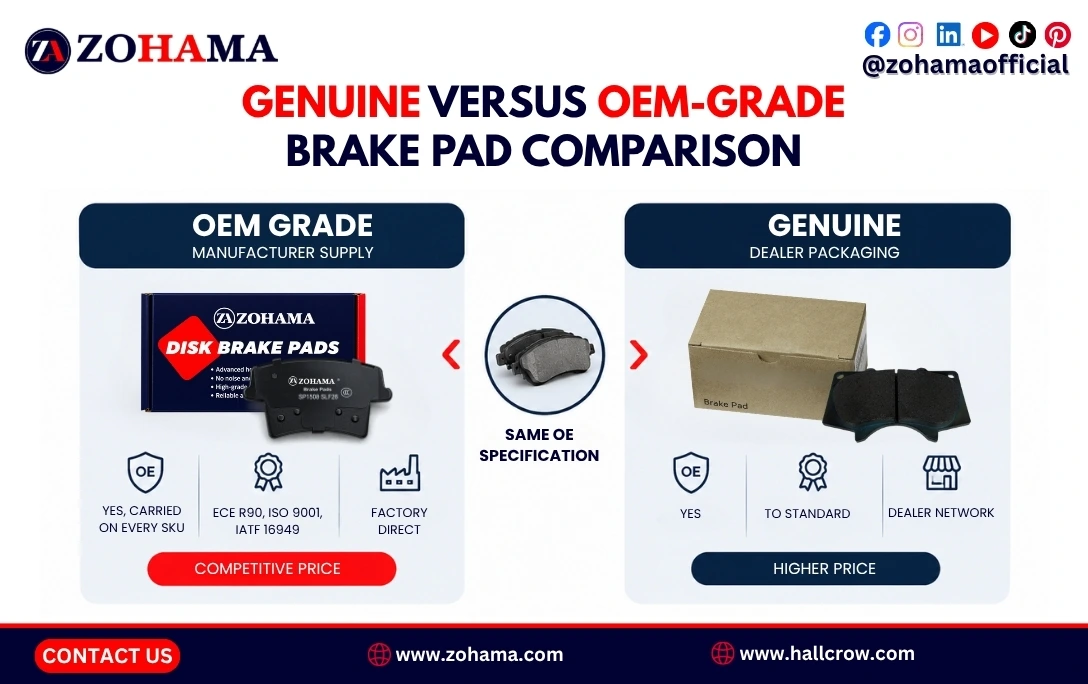
| Factor | Genuine (dealer box) | OEM-grade (manufacturer) |
|---|---|---|
| Specification | Original equipment spec | Built to the same OE spec |
| OE reference | Yes | Yes, carried on every SKU |
| Certification | To standard | ECE R90, ISO 9001, IATF 16949 |
| Price | Highest (dealer markup) | Factory-direct, no dealer premium |
| Best for | Niche demand that insists on the box | The core of a distributor’s range |
What a Distributor Should Order
For most of a range, the smart order is OEM-grade. It gives the fit, specification and OE reference of the original, so it performs like the genuine part, but it comes factory-direct without the dealer premium, so the distributor and the customer both keep margin. A small amount of dealer-genuine can be kept for the niche demand that insists on the branded box, and quality aftermarket has a place where price leads and an exact OE match matters less, but the backbone of a sensible range is OEM-grade bought by OE number.
What actually makes an OEM-grade pad perform like the original is the compound and the build, covered in the brake pad materials breakdown.
How to Order the Right One
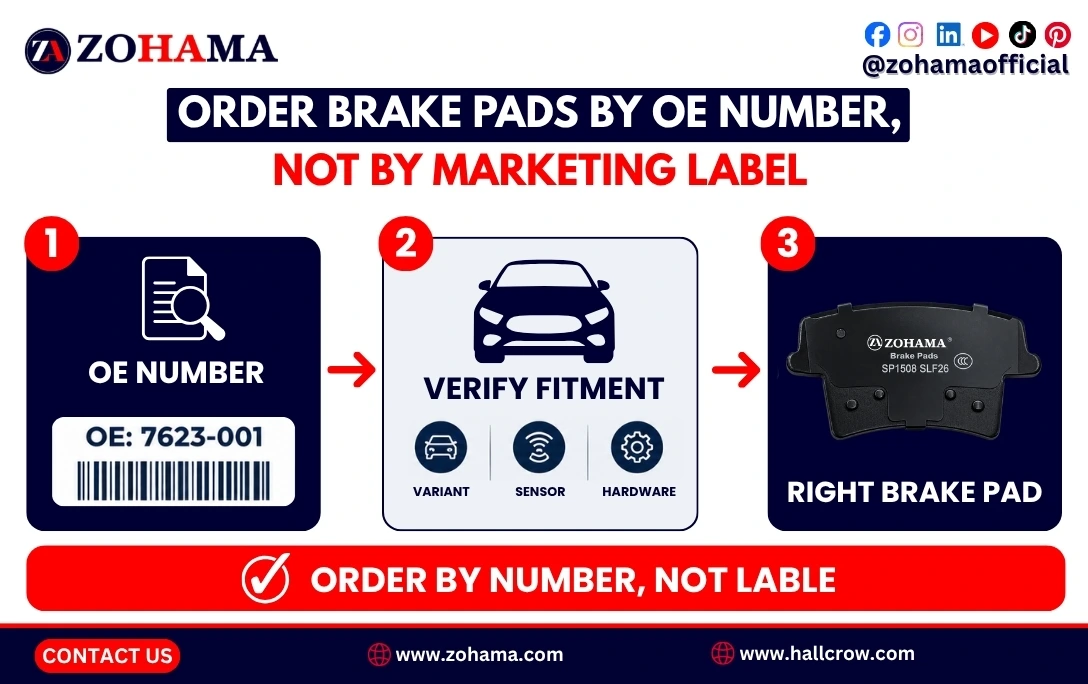
Whatever the label, the order is only correct if it matches the vehicle, so the OE number is what a buyer should order against. Match the OE reference to the exact variant, confirm the sensor and hardware where the application needs them, and you have ordered the right pad regardless of which marketing term is on the box. Ordering by label instead of number is how buyers overpay for genuine or under-buy on quality.
The brake pad part-number lookup guide shows how to confirm the exact pad by OE number before ordering.
Order OEM-Grade Factory-Direct
The clean answer to OEM versus genuine is to order OEM-grade, by OE number, factory-direct: original specification and reference, certified to ECE R90, without the dealer markup. The B2B brake pads page quotes against confirmed OE numbers, and for the wider passenger range see the light-vehicle brake pads catalogue. For structuring a volume order, the bulk buying car brake pads guide covers it.
Frequently Asked Questions
What is the difference between OEM and genuine brake pads?
Genuine pads come in the vehicle maker’s branded box through their dealer network at the highest price. OEM-grade pads are built to the same OE specification and carry the OE reference, but are made by a manufacturer and sold factory-direct without the dealer premium.
Are OEM-grade pads as good as genuine?
When built to the OE specification and tested to ECE R90, an OEM-grade pad performs like the genuine part. The main difference is the box and the price, not the fit or the function.
What should a distributor order?
Mostly OEM-grade by OE number as the core of the range, a little dealer-genuine for niche demand that insists on the branded box, and quality aftermarket where price leads and an exact OE match matters less.
How do I order the right pad whatever the label?
Order against the OE number, confirming the variant and the sensor and hardware. Matching by number, not by marketing label, is what guarantees the correct pad.
Conclusion
OEM versus genuine is mostly a question of the box and the price, not the specification. For a distributor the smart order is OEM-grade by OE number, factory-direct: the performance of the original without the dealer markup. Zohama manufactures OEM-grade pads to OE spec and supplies them factory-direct to distributors across the GCC, Africa and Central Asia.