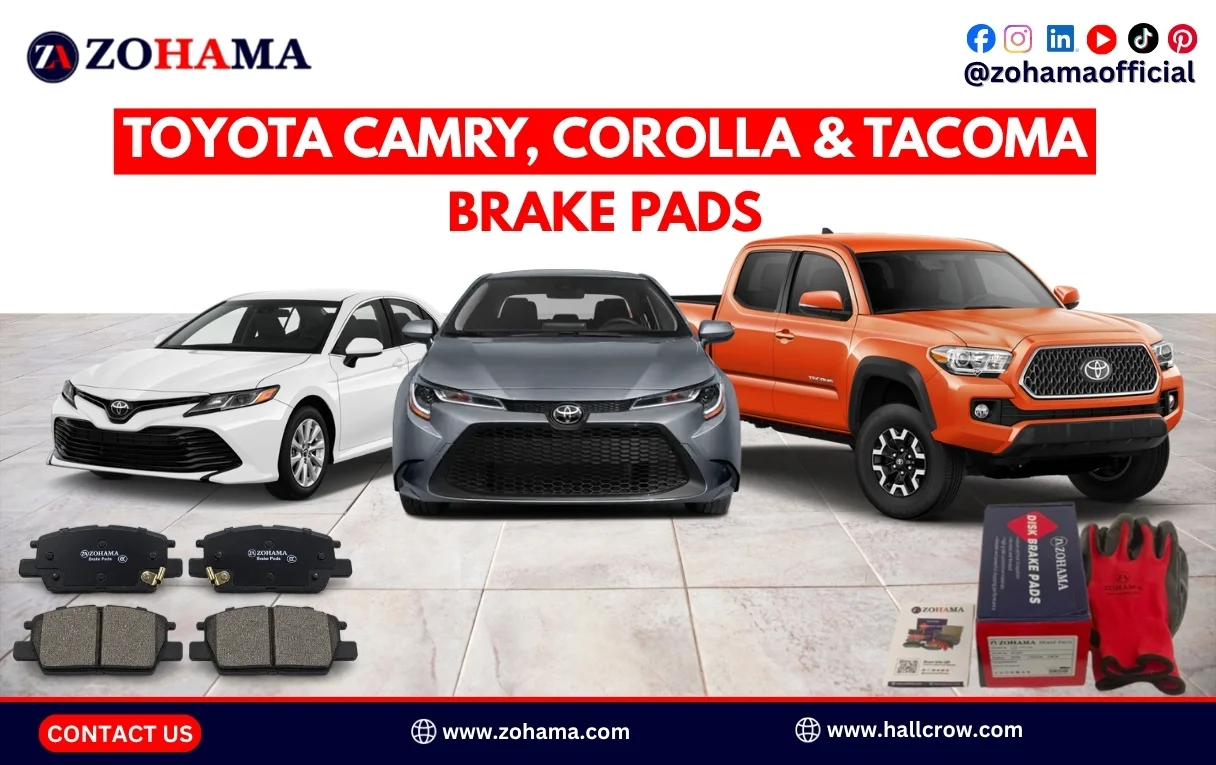
Three Toyota nameplates do a disproportionate amount of the work in a passenger-car brake pad range: the Camry, the Corolla and the Tacoma. Between a best-selling sedan, the most widely produced compact in history and a pickup that refuses to wear out, these three put more brake pad demand through a distributor’s shelf than almost any other group of models. This is a reference guide for stocking them: why they drive demand, how to order the right pad by OE number across their generations, and how to weight a first order so the three sell together.
Why These Three Toyotas Drive Your Brake Pad Demand
Demand for these models is deep and self-renewing for the same reasons across all three: enormous installed bases, long service lives, and owners who keep servicing rather than replacing the vehicle. The Camry anchors the mid-size sedan segment; the Corolla is a compact sold in vast numbers across every market Zohama serves; the Tacoma is a pickup whose owners drive it hard and replace consumables on a firm cycle. For a distributor that means three reliable, repeating lines rather than three occasional ones.
All three sit inside Zohama’s Toyota brake pads range, each pad matched to its OE reference and vehicle application, so your team can quote fitment without checking every item against a catalogue.
How the Three Models Break Down for Ordering
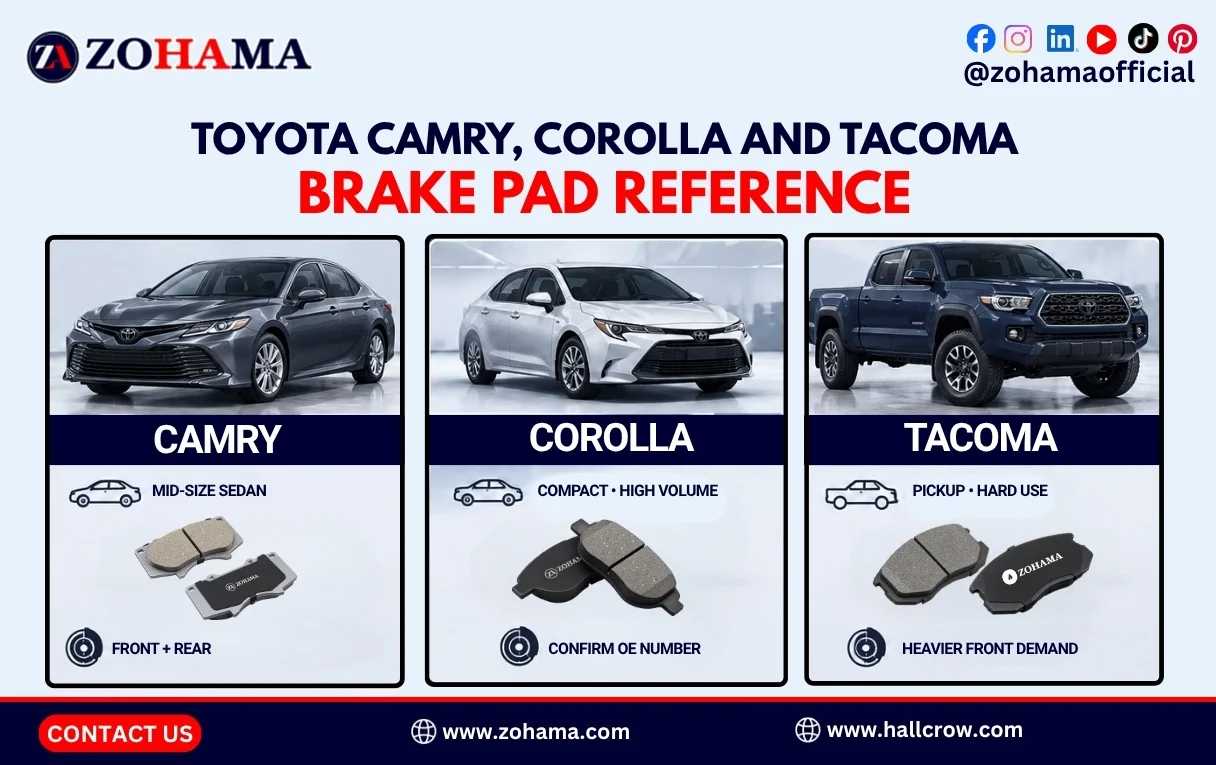
Each model behaves a little differently on the shelf. Use this as the starting frame, then match the exact pad by OE number:
| Model | Segment / demand | Ordering note |
|---|---|---|
| Camry | Mid-size sedan; steady, higher-value owners | Larger front pads; rear demand steady too |
| Corolla | Compact; highest volume across markets | Front and rear differ by generation; confirm the OE number |
| Tacoma | Pickup; hard use, firm replacement cycle | Heavier-duty fronts; strong front demand |
The Corolla is the one to get right first because it moves the most and has the most generational variation. Zohama lists common Corolla references such as its 04465-02220 and 04465-04707 pads on the OEM brake pads page, each tied to the exact application.
Match by OE Number, Not the Model Year You Assume
The single rule that keeps a Toyota order correct is to match by OE number rather than by the model name and a guessed year. All three of these models span several generations, and a Camry pad from one generation is not automatically the Camry pad from the next. Order by name alone and you will ship the wrong set often enough to lose the workshop’s trust and eat the return freight. Capturing the OE number, or the exact vehicle and axle, removes the guess.
The brake pad part-number lookup guide shows how to confirm you are matching the exact pad before it goes on the order, which is the habit that keeps a high-volume Toyota line clean.
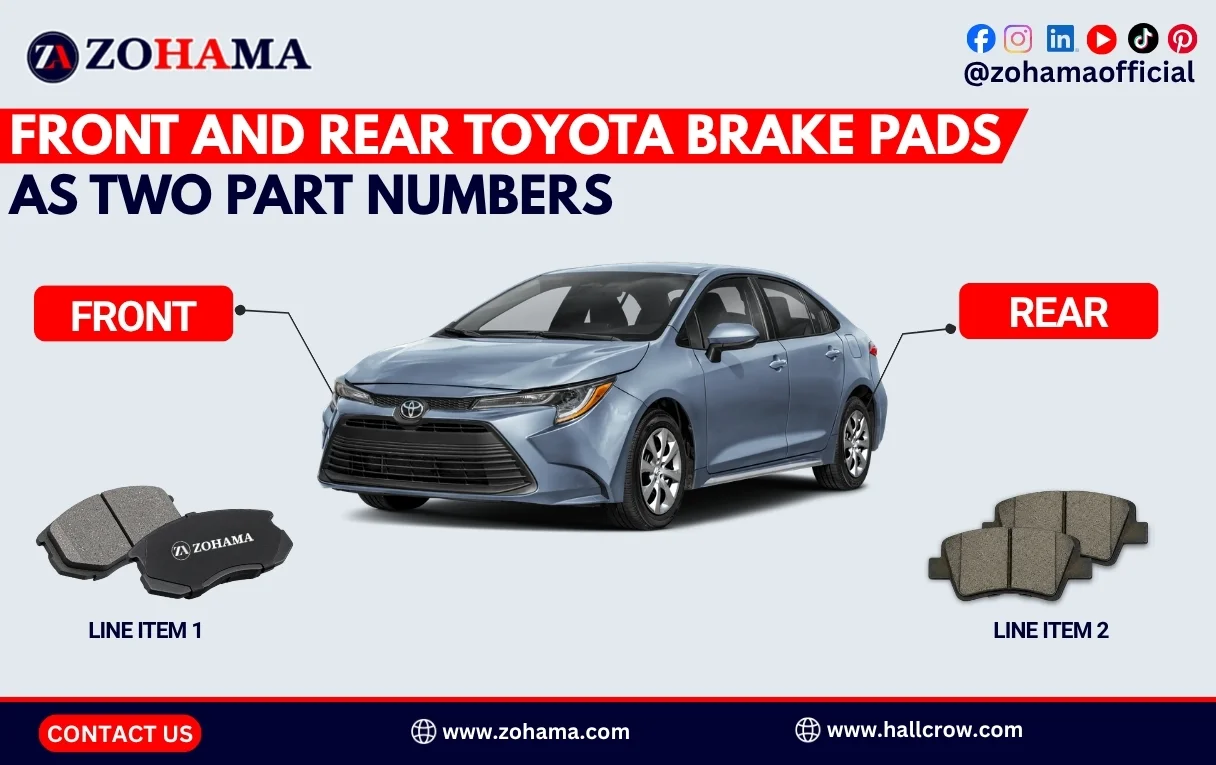
Front and Rear Are Two Line Items
On all three models the front and rear pads carry different numbers, so a single vehicle is really two SKUs on your shelf. Fronts wear faster and move more, so they carry the demand, but a range that stocks only fronts leaves the rear sale, and often the whole job, going to a competitor. Weight toward fronts, but carry the fast-moving rears for at least the Camry and Corolla, which see the most complete brake jobs.
Stocking the Three Together
Because these three cover sedan, compact and pickup demand at once, stocking them together gives a distributor broad Toyota coverage from a small, high-turnover group of SKUs. A sensible first order covers the front sets for all three, the fast-moving Camry and Corolla rears, and depth weighted to whichever model dominates your local market. That single group will answer most Toyota brake enquiries a general workshop sends you.
Browse the full model coverage on the Toyota brake pads page, and see how the wider passenger range fits together on the light-vehicle catalogue.
Order Your Toyota Range
Camry, Corolla and Tacoma are three of the most dependable lines a passenger-car distributor can carry, and getting the OE numbers and the front/rear split right turns them into repeat sellers. Send Zohama your Toyota part list for a quote, or join the distributor and partner program for factory pricing and priority stock on these high-turnover numbers.
Frequently Asked Questions
Why stock Camry, Corolla and Tacoma pads together?
Together they cover sedan, compact and pickup demand with a small group of high-turnover SKUs, giving broad Toyota coverage that answers most workshop enquiries from one part of your shelf.
How do I order the correct Toyota brake pad?
Match by OE number or the exact vehicle and axle, not by model name and a guessed year. All three models span several generations that can take different pads, and front and rear carry different numbers.
Should I stock rear pads as well as fronts?
Yes, at least for the Camry and Corolla, which see the most complete brake jobs. Fronts carry the volume, but stocking only fronts sends the rear sale, and often the whole job, to a competitor.
Can I order these Toyota pads wholesale with flexible MOQ?
Yes. Order volumes are structured around what a distributor actually moves, and you can request a sample on any new number before committing to a bulk quantity.
Conclusion
Camry, Corolla and Tacoma pull an outsized share of Toyota brake pad demand, and a distributor who stocks them by OE number, weighted correctly across fronts and rears, holds three of the steadiest lines in the range. Zohama manufactures Toyota-fit pads to OE spec and supplies them factory-direct to distributors across the GCC, Africa and Central Asia.