Choosing a supplier is the single decision that shapes a distributor’s margin, reputation and repeat business. For passenger car brake pads — a fast-moving, safety-critical product — the wrong supplier means returns, warranty claims and lost customers, while the right one becomes a long-term advantage. This guide sets out exactly how to evaluate and choose a passenger car brake pad supplier: the criteria that matter, the questions to ask, and the red flags to walk away from.
If you are still deciding where and how to source in the first place, start with our guide on sourcing light-vehicle brake pads from China; this article focuses specifically on the supplier-selection decision.
Manufacturer or Trading Company: Which Supplier Type Fits You
Before comparing individual suppliers, decide which type suits your business:
- Manufacturer (factory). Best pricing and quality control, direct technical support, and the strongest fit if you order steady volumes of car pads.
- Trading company. Easier for mixed or smaller orders and simpler communication, but adds a margin and puts a layer between you and quality control.
For a distributor building a passenger-car catalogue, a capable manufacturer is usually the better long-term choice. Our overview of the top brake pads manufacturers in China is a useful reference point.
The Core Criteria for Choosing a Car Brake Pad Supplier
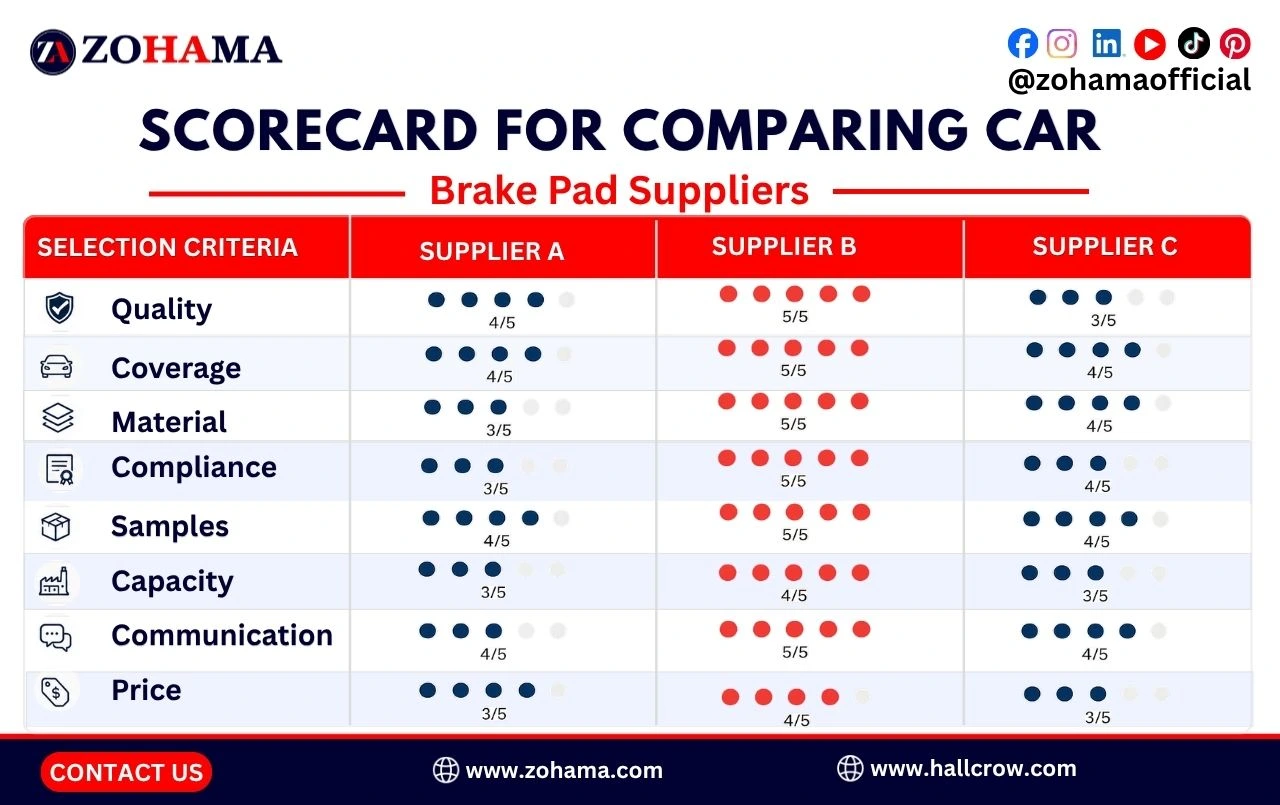
Score every candidate supplier against the same criteria so you compare like-for-like rather than on price alone:
| Selection criterion | What a strong car-pad supplier shows |
|---|---|
| Quality systems | Recognised automotive quality certification, batch consistency and product test data. |
| Model coverage | References across the passenger-car platforms you actually sell, not just a few popular ones. |
| Material range | Ceramic, NAO and low-metallic options so you can match each market’s needs. |
| Compliance | ECE R90, copper-free or asbestos-free status for your destination markets. |
| Samples & validation | Willing to provide samples and be transparent about specifications. |
| Capacity & lead time | Ability to meet your volume and re-order reliably, with realistic lead times. |
| Communication | Responsive, clear, and able to give technical/part-number support. |
| Pricing transparency | Clear quotes with terms spelled out and no hidden costs. |
Quality systems deserve special attention. Ask whether the supplier works to a recognised automotive standard such as the IATF 16949 automotive quality standard or at least ISO 9001 quality management, and request the test data behind their claims.
Questions to Ask Before You Commit
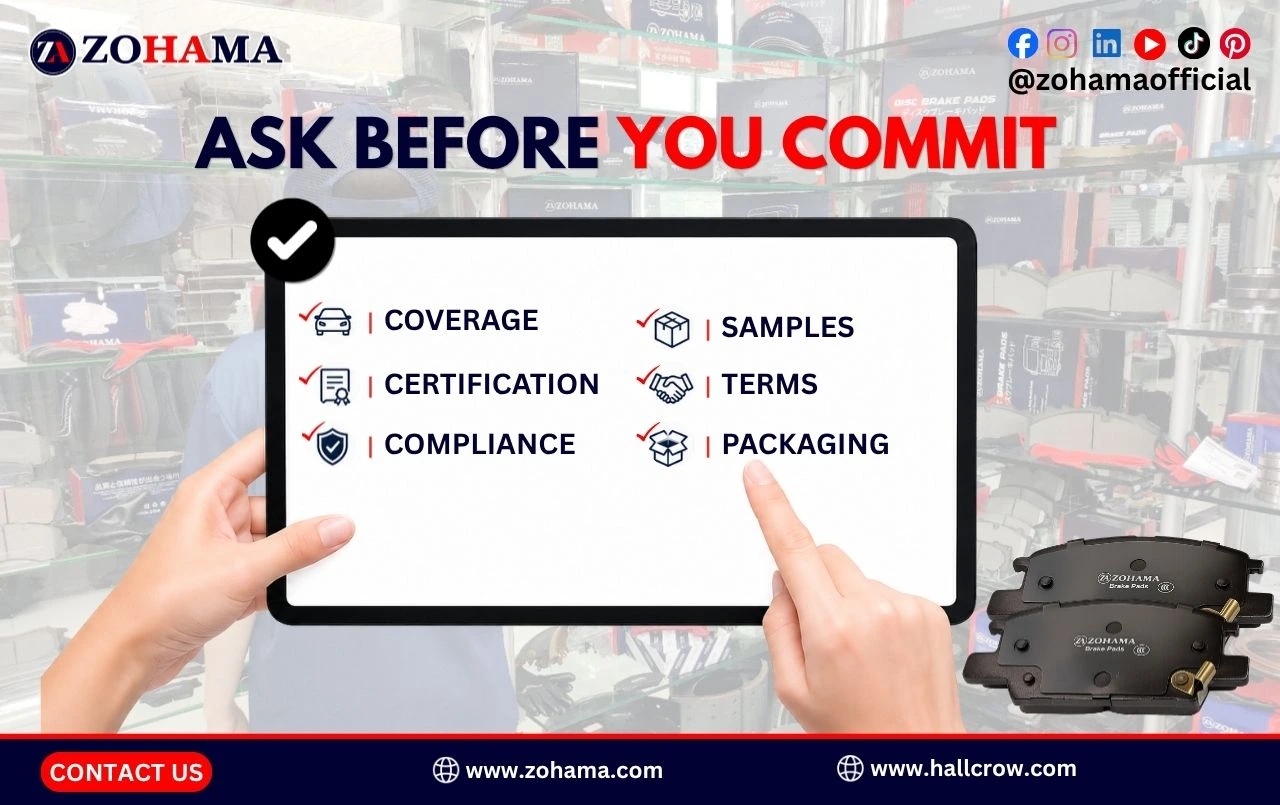
A short, direct set of questions quickly separates capable suppliers from the rest:
- Which passenger-car platforms and part numbers do you already produce?
- What quality certification and product test reports can you share?
- Which compliance standards (ECE R90, copper-free, asbestos-free) do your pads meet?
- Can you provide samples, and what is the lead time for a first production order?
- What are your terms — pricing, packaging options, and shipping arrangements?
- Do you offer neutral, OEM-style or private-label packaging?
Framing your enquiry around exact references makes answers far more reliable — see our brake pad part-number lookup guide.
Red Flags to Watch For
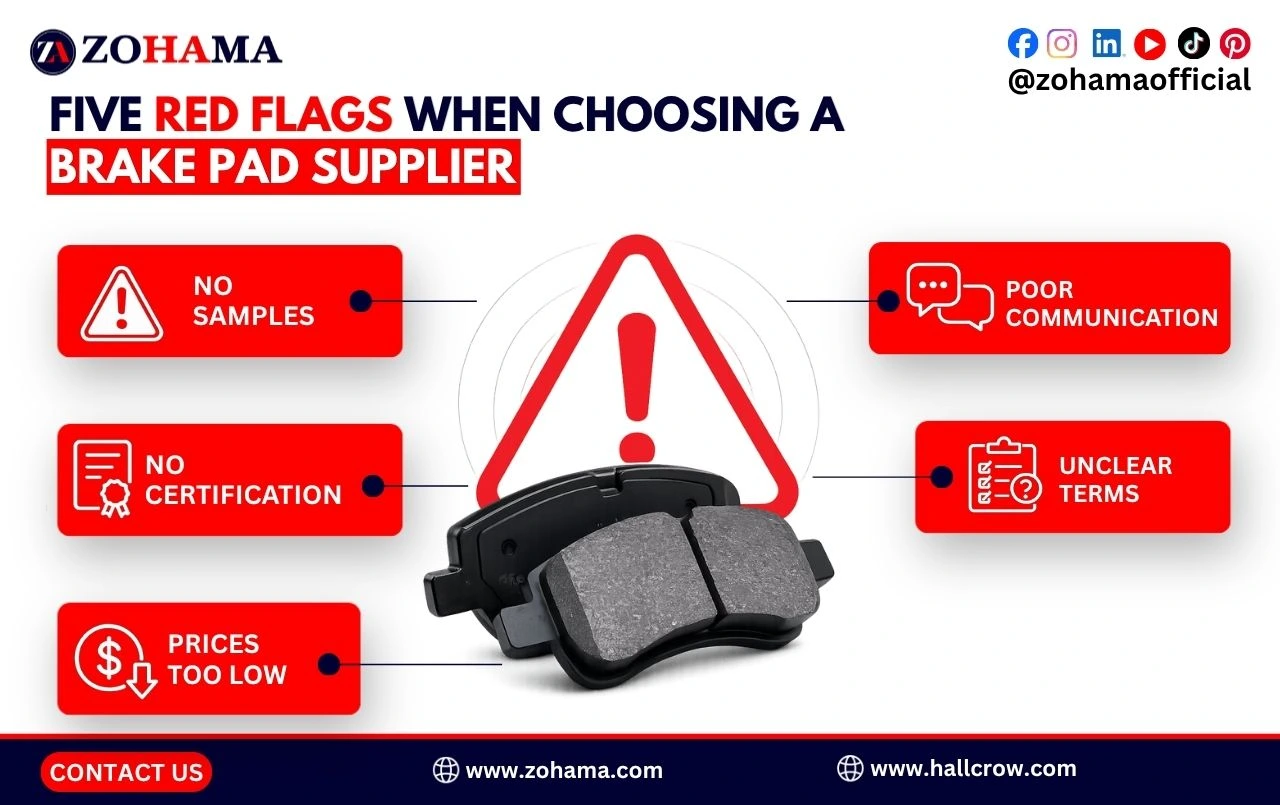
- Reluctance to provide samples or vague answers about specifications.
- No verifiable quality certification or unwillingness to share test data.
- Prices far below the market — usually a sign of inferior material or missing compliance.
- Poor or slow communication during the enquiry stage, which rarely improves after the order.
- Unclear terms or hidden costs that appear only after you commit.
How to Compare Suppliers Side by Side
Turn the criteria above into a simple scorecard. Rate each shortlisted supplier (for example 1–5) on quality, coverage, compliance, samples, capacity, communication and price, then weight the factors that matter most to your market. The highest total — not the lowest price — is usually the supplier that protects your business best. Vetting the factory itself is a related step covered in our guide on
what to look for in a Chinese auto parts factory.
Verify Before You Commit
Never place a full order on a catalogue match alone. Confirm your choice with:
- Samples to validate fit, finish and friction quality.
- A quality check against the approved sample before shipment.
- A factory audit — in person or remote — for larger commitments.
Understanding pad construction also helps you judge quality — our brake pad materials breakdown and OEM brake pads pages explain what to look for.
Build a Long-Term Supplier Relationship
The best sourcing outcome is not a single good order — it is a reliable supplier you can grow with. If you want a manufacturing partner with broad passenger-car coverage, proper certification and part-number-level support, explore our distributor and partner program to request a catalogue and pricing for your market.
Frequently Asked Questions
Should I buy car brake pads from a manufacturer or a trading company?
For steady volumes and a growing catalogue, a manufacturer usually offers better pricing, quality control and technical support. Trading companies suit smaller or mixed orders but add a margin and a layer between you and quality control.
What certification should a car brake pad supplier have?
Look for a recognised automotive quality standard such as IATF 16949, or at least ISO 9001, plus product test data and the compliance status (ECE R90, copper-free, asbestos-free) required for your market.
How do I compare two suppliers fairly?
Score both against the same criteria — quality, coverage, compliance, samples, capacity, communication and price — and weight the factors that matter most to your market. Decide on total value, not lowest price.
Do I really need samples before ordering?
Yes. Samples validate fit, finish and friction quality, and are the cheapest insurance against a costly wrong order. Reluctance to provide them is a red flag.
Conclusion
Choosing a passenger car brake pad supplier is a decision, not a gamble. Decide on the supplier type, score every candidate against clear criteria, ask direct questions, watch for red flags, and verify with samples before you commit. Get this right and you gain more than a good price — you gain a dependable supply line that keeps your customers coming back.